
1450 Owens

Owens Photos by Jason O Rear dpi copy

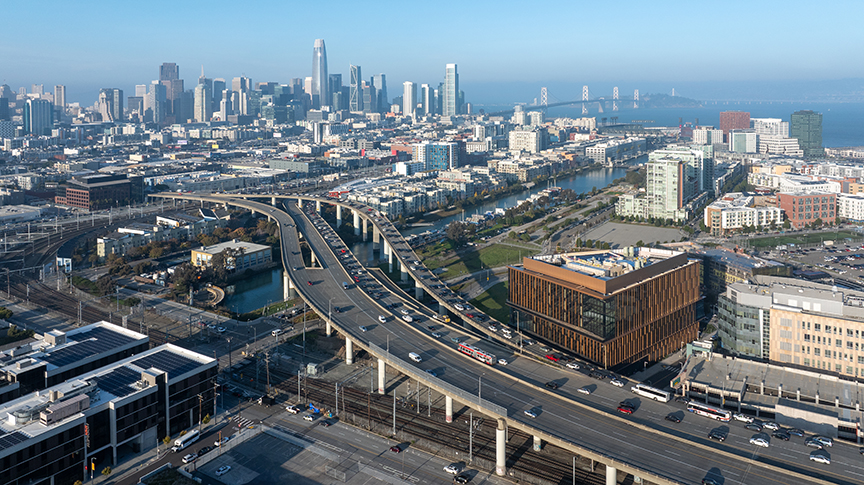
The site sits at the western edge of the Mission Bay district alongside the I-280 viaduct and Caltrain commuter rail line, as it marks the north end of a row of commercial office, life science and medical buildings along that I-280 corridor, before the freeway drops down to grade at Townsend Street.

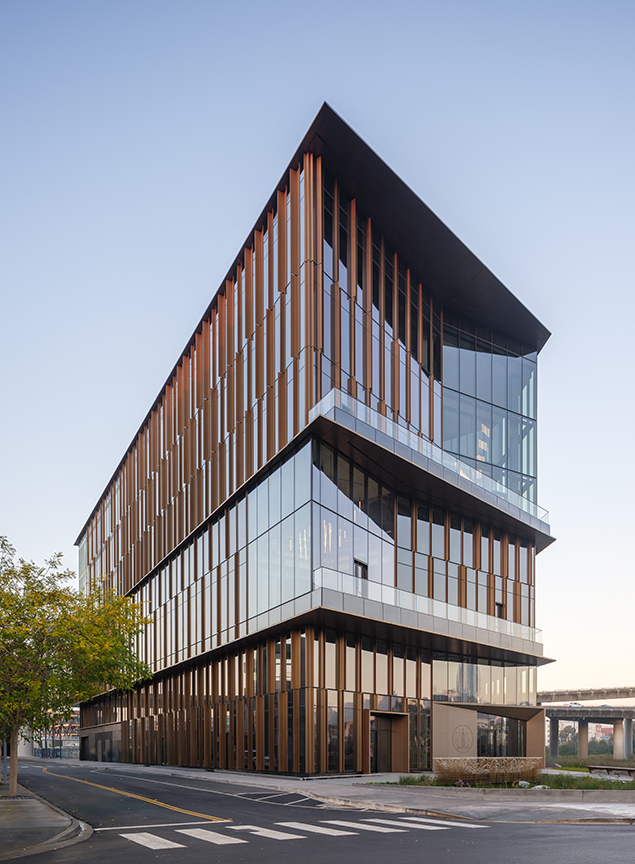
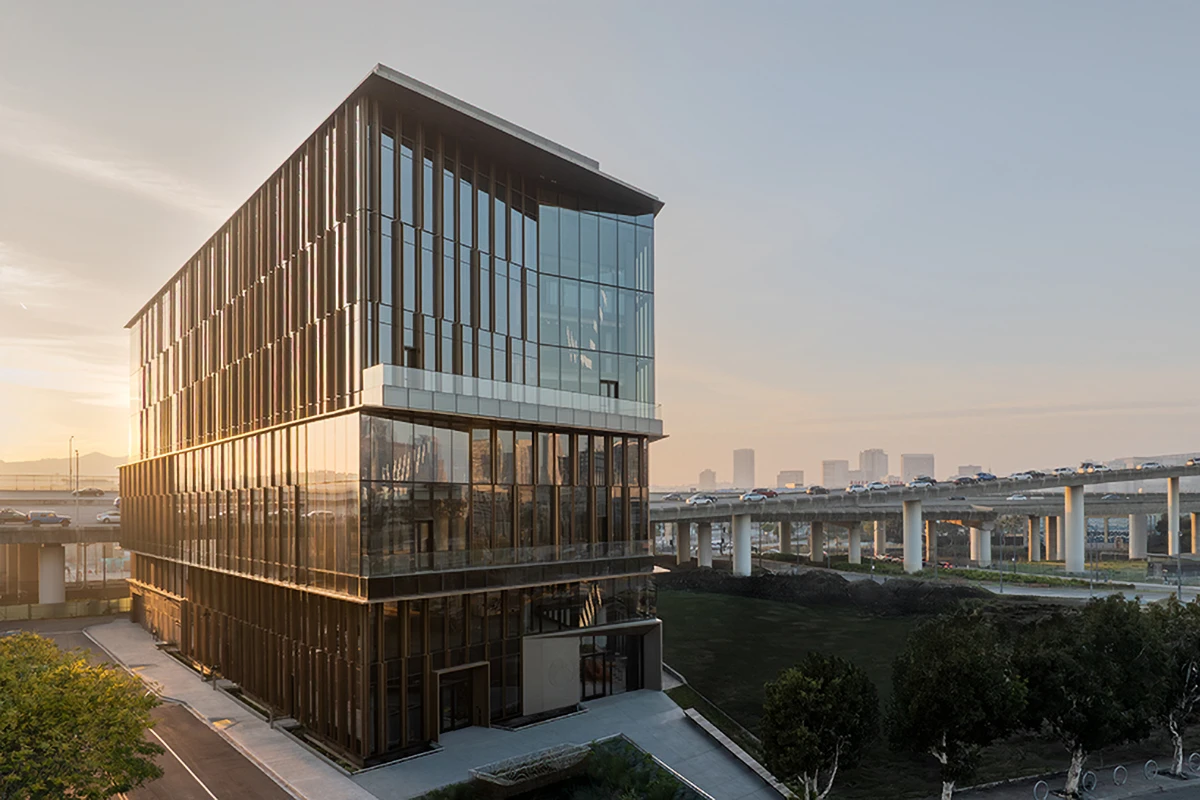
The building’s form responds to three factors in particular: the dynamics surrounding the site, the constraints of the parcel shape and buildable area, and the prominence and visibility a new freestanding building commands at this locale. The footprint is essentially established by the site’s shape minus utility/infrastructure easements and setbacks. The resulting mass evolved from an earlier twelve story tall version (after input from neighborhood and stakeholder groups) to the ultimate seven-story built form. Through the design process, a strategy emerged of ‘carving out’ four corner atriums and a double-height entrance lobby within.

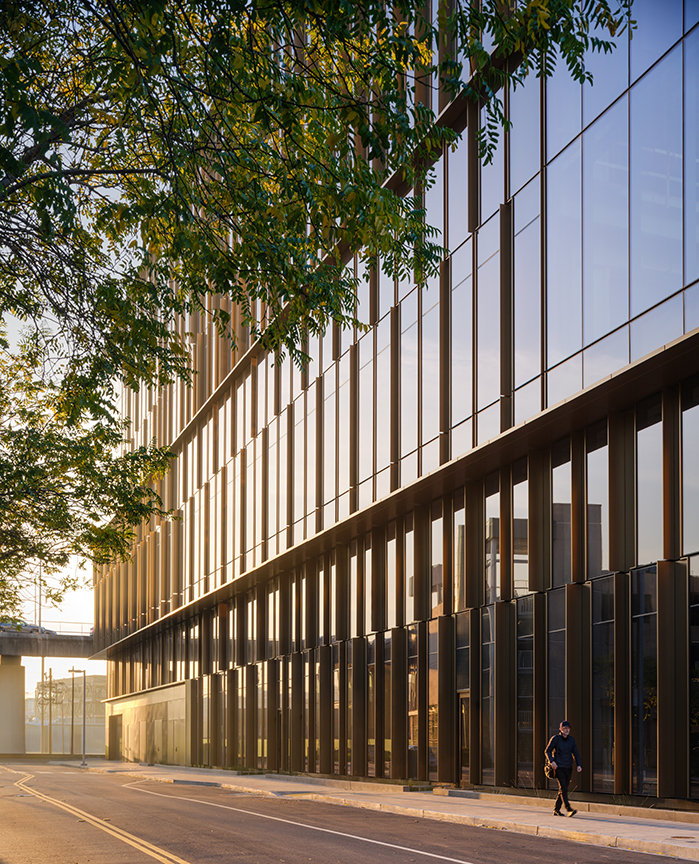
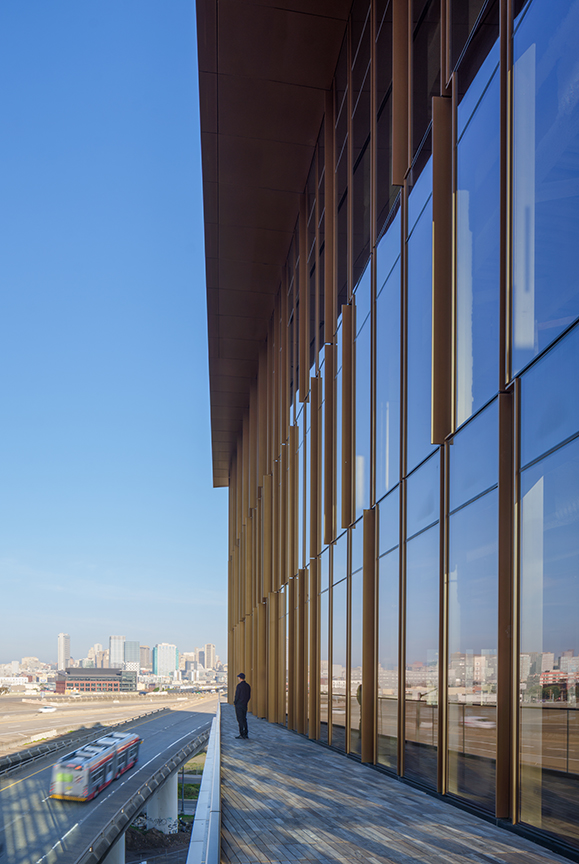
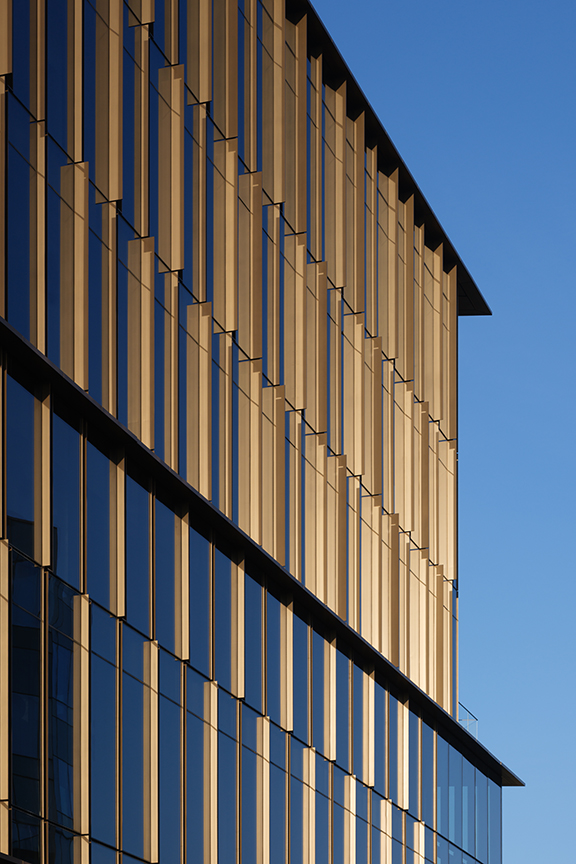
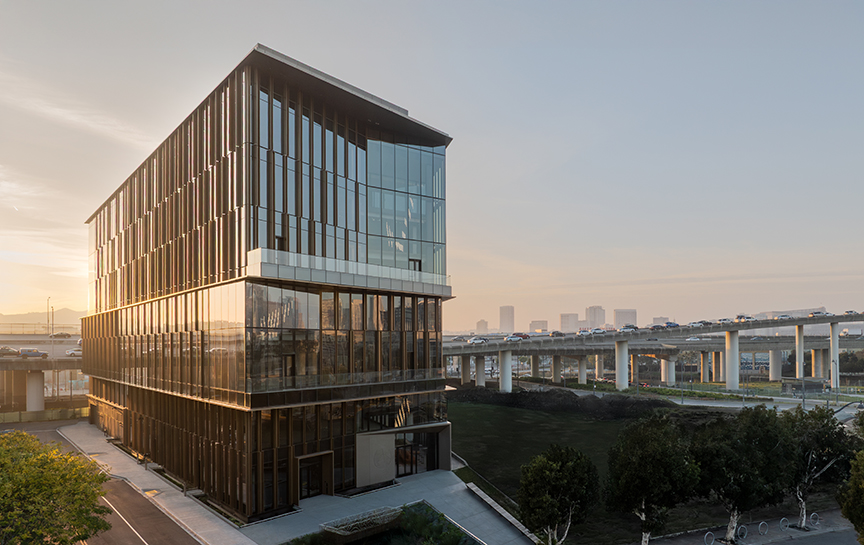
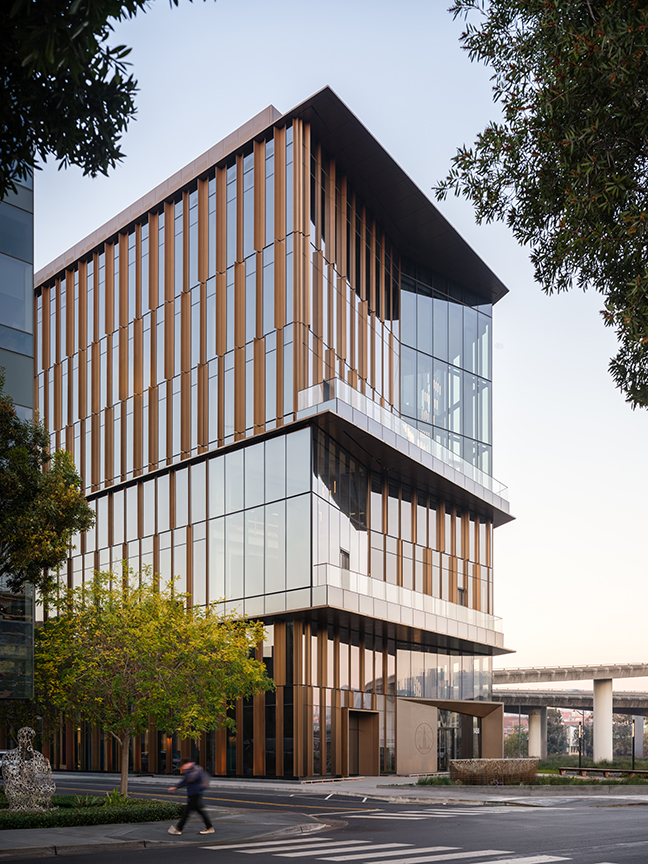
The massing forms a shifted stack of two-story and three-story blocks. The east and west facades are articulated with building-width balconies and subtle inflections at the corner atria’s inside edges. The façade’s rich texture and pattern further articulate the building’s expression – a pattern that emerges from a curtain wall system employing a gradient rhythm of shading fins and reveal panels. Key metal façade elements are powder-coated in a mica paint that subtly shifts tone and hue with the light of day. A locally-made, faceted precast lightweight concrete entry portal announces entry from the landscaped plaza at the corner of Owens Street and Nelson Rising Lane.

While the project’s site and situation demanded a responsively designed building demonstrating architectural design excellence wherever possible, an equal amount of careful attention was given to sustainable building strategies and the experience of the occupants, from lobby to upper workspace floors.

//jury comments

Architecture is ultimately about resolution and about what how one sees through details to the conclusion of construction; this building really does that with great merit. It is clearly a building that is essentially of the freeway. But it’s also a building of wonderful sculptural qualities at a large urban scale. A tough but handsome, well resolved, transparent, welcoming addition to this part of San Francisco.
//framework for design excellence measures
Measure 1: Design for Integration
The building’s wedge-shaped plan form, derived by maximizing the irregular site, capitalizes on both dramatic outward views from the building to San Francisco’s hill, downtown and the Bay beyond, while responding to views of the building from Potrero Hill on one side, and from passing cars on I-280 and an active public open space on the other. The façade was designed to be rich in three-dimensional depth and material quality. This can be experienced in the subtly stacked, shifted and inflected two and three story blocks that make up the massing, as well as in the curtain wall’s gradient porosity of the fin and reveal panel system that brings further articulation to the architectural expression. Two and three story atria were generated in the design process, when the square footage of the seven story second design iteration massing over the allowable total floor area. Through strategic subtraction from the floorplates’ corners, the double and triple height spaces resulted in an improvised positive outcome for building occupants from community engagement and feedback about the project massing. A higher than typical level of quality in the facade was ultimately achieved through careful analysis of thermal performance and project budget.
Measure 2: Design for Equitable Communities
Yes, the project was presented to the surrounding multi-family residential, institutional commercial Mission Bay community, with feedback incorporated. As the design was also prominent in the viewshed toward downtown from Potrero Hill to the south of the project, meetings with key neighborhood associations there were also held. These meetings greatly shaped the project’s overall massing through schematic design and entitlement. An earlier twelve story massing – tower on podium expression – was ultimately reduced in height from twelve to seven stories, with larger floorplates, no podium, and the introduction of four corner atriums.
Measure 3: Design for Ecosystems
Located at the edge of the established bird protection area, bordering an open space park, and close to the Mission Creek Waterway and the bay, the project site participates in local bird migration, resting, and habitation. Fritted bird-safe glass at lower levels and glazed corners discourage collisions. Onsite stormwater retention holds the rain which falls on constructed hard surface, emulating the patterns of water flow of an undeveloped and vegetated site. Lastly, the site is planted throughout with native drought tolerant vegetation, which flourishes with the natural cycle of rainfall and does not require irrigation.
Measure 4: Design for Water
The onsite stormwater management is integrated within the lanmdscape of the public entry plaza. It is also designed to work in relation to a public artwork situated within the plaza landscape.
Measure 5: Design for Economy
A vibration study was used to right-size the structural system. Office use allows for more vibration, while typical lab use is more stringent. A vibration study was used to tune the structure to provide a reasonable amount of floor area at the more stringent criteria, avoiding unnecessary use of steel. If needed in the future, mass-tuned damper units can be installed or demounted in particular structural bays to selectively increase performance.
Measure 6: Design for Energy
Temperature water resets for HHW and CHW are in place to allow for Energy savings, Duct static pressure resets for VAV systems to save AHU fan energy, HHW equipment is modular to allow to adjust based on building load and chillers have different sizes to accomodate to low building loads, CA T24 compliant Lutron Vive lighting control system
Heat build-up in the atriums was a concern, and a computational fluid dynamics analysis was performed to optimize where cooling was introduced into the volumes, and tune the amount of cooling flow.
Measure 7: Design for Well-Being
A daylight study was done to assess glare, particularly at the north side of the building, where the team was curious whether the arrangement of fins and opaque panels in the façade would adequately control for glare without the need for roll-down shades. The primary views, of Mission Bay, Downtown San Francisco, the Bay Bridge and the bay, are all from the north, and providing an environment where shades would not be needed for glare meant those views could always be available. By tuning the façade elements, perceptible glare was effectively eliminated for the north side of the building.
Measure 8: Design for Resources
The project utilized the following strategies, suitable to meet the LEED V4.1 Materials & Resources credits: Storage and Collection of Recyclables, Construction and Demolition Waste Management, Building Product Disclosure and Optimization – EPD, Building Product Disclosure and Optimization – Material Ingredients, Construction and Demolition Waste Management Planning.
Exterior materials were selected for their material durability and longevity of finish. These consisted of painted and anodized aluminum, glass, stainless and galvanized steel, concrete, and FSC certified tropical hardwood deck pavers.
All wood used on the project was FSC certified. 
Measure 9: Design for Change
The project is designed for lab and office occupancies, and can accommodate any percentage mixture thereof, all the way up the most building system demanding, 100% laboratory use. This gives the developer ultimate flexibility with tenanting composition, and assures future flexibility for any mix of those uses.
Tenant spaces on the ground floor can also accommodate retail space, should that prove valuable in the future.
Measure 10: Design for Discovery
Double and triple-height atriums at the building corners, give occupants on every floor access to interesting interior volumes of space, and dedicated moments of striking views. Balconies at levels 3 and 5 also provide dramatic moments of outdoor space.
Stormwater delivered to a long narrow bioretention planter hugging the building distributes along a long, open, stainless steel channel, with spillover notches cut high in its sides. This ensures water distributes evenly along the length of the bioretention, rather than pooling just at the point rainwater is introduced, and provides an expressive moment of visibly performative drainage.”
Skip to content